A Pilot Sponsored By Red Lion Gasoline Decided He Should Make A Real Lion His Co-Pilot - Jalopnik
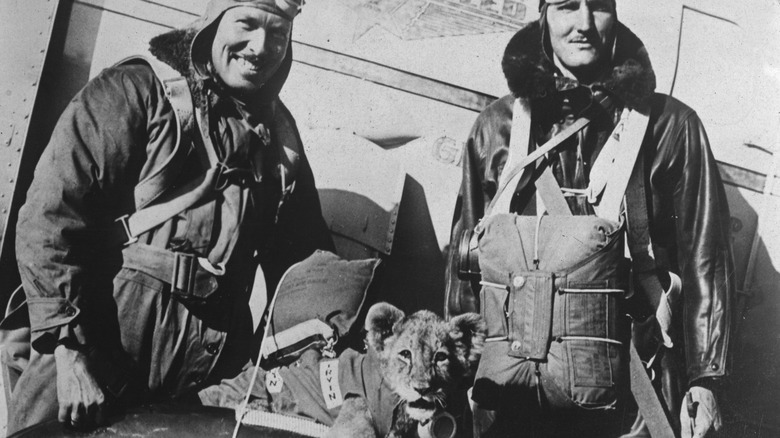
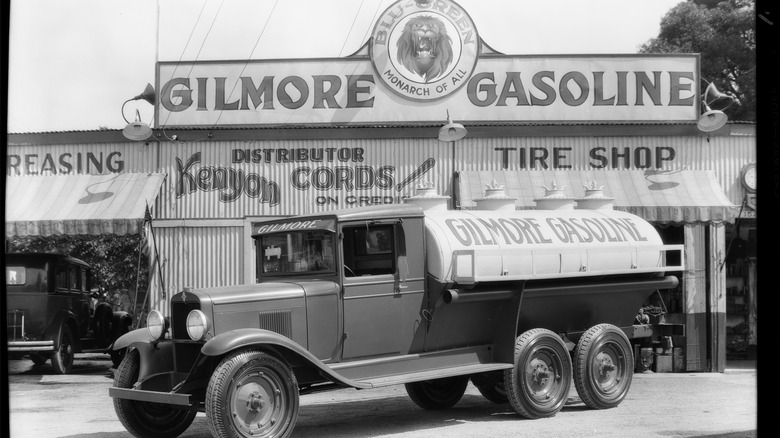
Celebrity in the 1930s was different from celebrity today. In early 1930, celebrity pilot Roscoe Turner and Gilmore Oil set a transcontinental flight record aboard the Lockheed Express, making the run from New York to Los Angeles in just 18 hours, 42 minutes. At the time Gilmore Gasoline was branded as "red lion," touting the fuel as giving your car's engine more "roar." A flamboyant showman, Turner convinced the owner of a lion farm to donate a cub for the record attempt. The 3-week-old cub he dubbed Gilmore the Flying Lion was used in his stunts, including the speed trials and the then-world-famous Cleveland National Air Races.
Turner was an air racer and aerobatics ace, well known for his flair for the dramatic. Having learned to fly for the U.S. Army during World War I, Turner quickly became a nationally renowned barnstormer, performing wing-walking stunts and artfully choreographed parachute jumps. In 1922 he served prison time for buying a Curtiss JN-4 that turned out to be stolen government property. Turner later opened the Roscoe Turner Flying Circus before moving on to flying stunts for films and starting an airline. When the Great Depression killed his entrepreneurial spirit, he jumped back in speed planes and secured sponsorship from Gilmore Oil.
Turner and his flying lion gained international acclaim for their stunts from April through December of 1930. After the cub grew too large to continue flying, Turner's notoriety continued to bloom. He won his first Bendix Trophy race in 1933 and Thompson Trophy air race in 1934 after working with Jimmy Wedell and Harry Williams to develop a new low-wing speed plane. The monoplane was little more than a seat, a tiller, and a Pratt & Whitney nine-cylinder radial engine.
What of the lion?
Brandstaetter Images/Getty Images
Jimmy Doolittle, a Turner competitor before going on to flying fame in World War II, rated him highly.
"You always knew when Roscoe was around. His broad smile topped with a broad waxed mustache was the first thing you noticed," Doolittle said, as recounted on historynet. "Then you saw his uniform — highly polished boots, riding breeches, powder blue military jacket with diamond studded wings, sometimes a Sam Browne belt or a silver buckle, gold-and-crimson helmet and goggles. Then you heard him joshing with everyone, anxious to meet anybody he hadn't known before. You couldn't help but like him."
But Turner got into trouble with the Humane Society when it heard about the flying lion. To satisfy its complaints, Turner outfitted the 17-pound cub with a static-line parachute. For several months Turner continued to attempt point-to-point aviation speed records, including a run from Vancouver, Canada to Aguascalientes, Mexico with the lion in tow. All paid for by Gilmore Oil (no relation to the top-rated Gilmore Car Museum).
Gilmore the lion wasn't just a plane passenger, but an ambassador for the company, for Turner's career, and for aviation in general. The cub would turn up anywhere Turner went, including air shows, movie premieres, and evenings on the town. But by the time the lion was 10 months old he weighed 150 pounds, and Turner knew it was time to part ways. Gilmore had logged over 25,000 miles in the air during his tenure as spokeslion for an oil company.
Gilmore the Lion is still an enormous part of American marketing history, showing the power of outside-the-box thinking. While the petrochemical company is no more, merged decades ago into the company that would become Mobil, its legacy is one of creative marketing that captivated the nation.
What happened to Gilmore?
University Of Southern California/Getty Images
Despite his short-lived time as a flying lion, Gilmore rose to the level of cultural institution nearly 100 years ago, with his name known around the country. Following his career in aviation, Gilmore spent nearly a decade in captivity, living in a cage at the Burbank airport in Southern California, before being moved to a different cage at a Gilmore gas station in Beverly Hills. Once a beloved symbol of power and speed with a flamboyant best friend in the sky, Gilmore had become little more than a static display, feet planted on terra firma. Still, through the 1930s Gilmore would make periodic publicity appearances at Turner's side, though never again airborne.
In 1940 Gilmore was returned to the farm where he was born, the Louis Goebel Lion Farm in Agoura, California. He lived on the grounds for another decade before passing, with Turner occasionally visiting and continuing to send money for his care. Gilmore died on December 17, 1950 at the ripe old age of 20.
Gilmore's remains were sent to a taxidermist for mounting, and moved to Turner's Indianapolis, Indiana home. When Turner died in 1970 the stuffed Gilmore was entered into the collection of the Roscoe Turner Museum, which opened that year. When it shuttered in 1972 he was transferred to the National Air and Space Museum, our Amber DaSilva's favorite automotive museum. Gilmore became part of the collection and remains there to this day. According to the museum, the stuffed Gilmore weighs a full 328 pounds.