British broadcasters should merge into single platform to survive, says Jeremy Clarkson
Jeremy Clarkson has called on British broadcasters to merge into a single “Britflix” platform to survive, as he warned that senior producers were continuing to “drain away” from the cash-strapped TV industry.
The former Top Gear presenter said that having just finished filming the sixth season of his Amazon Prime show Clarkson’s Farm, there were now many members of the crew wondering where they would find their next job.
Clarkson said competition from streamers and digital platforms such as YouTube meant that Britain’s main broadcasters should come together to make “bigger, fewer, better programmes”. It follows an exodus of experienced TV producers in recent years.
The 66-year-old said he believed the BBC would eventually merge with Channel 4, an idea both broadcasters have repeatedly rejected. However, he said the industry in the UK would have to go far further to compete.
“I actually think that television in this country can only survive – and should do this – [if] the whole lot merge,” he said during an appearance at the RTS London convention. “BBC, ITV, Sky, Channel 4, Channel 5.
“There’s 35, 40 people on the [Clarkson’s Farm] crew who are now sitting at home thinking, ‘how are we going to pay our mortgage?’ There’s very little work for producers and crew out there.
“I know a huge amount of producers that I’ve worked with over the years, really, really clever people – decent, sensible, hard-working people – who cannot find work in the industry. They cannot find it, and they’re making these smaller and smaller programmes with fewer and fewer people involved in the making of them.
“People are draining away from the industry – this huge pool of talent – and I think that if we had one great big Britflix, let’s call it, where you could all come together and actually make properly good … but bigger, fewer, better programmes.”
Clarkson said BBC News should be separated and funded through a licence fee.
Despite working with Amazon, a major streamer, Clarkson said he thought he would have to come up with an even bigger idea to compete with the rise of content creators on social media.
“We’re currently thinking about what we do after Clarkson’s Farm, and it’s going to have to be something bigger to stand out, to protect us from this onslaught from [social media content] underneath,” he said. “It has to be unbelievably ambitious.
“It’s very difficult to make a television show work unless you’re cooking on the moon or doing something incredible, and that’s where I think television has to get bigger.”
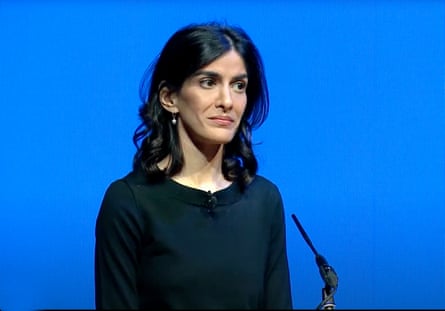
Clarkson’s comments are a sign of the continuing angst in the TV world over the future of the industry in Britain.
The idea of merging UK broadcasters has been raised many times in recent years, while the explosion of competition from global platforms, as well as significant inflation in the costs of making television, has led to several recent mergers.
Sky announced a long-awaited £1.6bn deal to buy ITV’s broadcasting and streaming arm earlier this year, creating the UK’s biggest commercial broadcaster. In the US, Paramount has a proposed $81bn merger with Warner Bros Discovery.
While the BBC and Channel 4 continue to reject merger talk, it is increasingly clear that the BBC will host Channel 4’s content on its iPlayer platform. It would be a huge boost to Channel 4, which recently announced plans to cut 340 jobs before the end of the year, reducing its workforce by more than a quarter.
Asked about moving Channel 4 content on to iPlayer at RTS London, Priya Dogra, Channel 4’s chief executive, said: “I don’t see why not.”
“There’s lots of considerations because Channel 4 content is monetised by advertising, so iPlayer has to accommodate that,” she said.
“But the idea of having a platform that’s British-owned, that showcases public service broadcasting content, particularly content that’s made without profit motive, I think is important.”