Control Resonant Violates the Number One Commandment of Video Game Lore
Follow
Link copied to clipboard

Published Sep 26, 2026, 10:00 AM EDT
Giovanni Colantonio is a video game journalist who has covered the industry for two decades. He was formerly a senior editor at Digital Trends and has contributed to publications like Inverse, Fanbyte, and Hard Drive. His specialty is criticism, as he’s focused on a modern approach to video game reviews that’s focused on the nuances of how interactivity communicates to players. He is currently a member of the New York Video Game Critics Circle.
I ain't reading all that
 Image: Remedy Entertainment
So much of Control, Remedy Entertainment’s 2019 paranatural shooter, sticks with me today, but the one thing I really remember is its lore. Its setting, a Brutalist Manhattan office building called The Oldest House, is littered with paperwork covered in black redactions, so much of which explains (or hides) what exactly is happening at the Federal Bureau of Control. It was so memorable that, these days, I can’t see blacked out text without thinking of Control.
It makes sense, then, that Remedy would double down on what it did best for Control Resonant. Though the sequel takes the series out of The Oldest House and onto the Hiss-infected streets of Manhattan, protagonist Dylan Faden still stumbles upon plenty of notes and audio logs left behind in an apocalyptic event. But what should be a selling point for Resonant is one of its minor pain points: There’s just too much lore to sift through.
That’s not a knock against the quality of Remedy’s writing, mind you; every piece of lore I’ve found in Resonant so far is top-notch. Something as simple as a tuning fork puzzle in a subway gets elevated by notes that paint a picture of a frustrated research team trying to understand why they keep teleporting around. It makes every piece of Resonant’s world feel narratively motivated rather than something that’s there for the sake of gameplay. That’s what puts Remedy head and shoulders above so many of its peers as a big-budget developer.
The problem is more in the pace at which they are doled out. Early on, you find lore logs at a steady clip. A few here and there to set the scene, and they only take a quick pause to read. The volume of them goes up the deeper you get, and it gets overwhelming fast. In one mid-game mission set in an underground labyrinth, Dylan finds several FBC test sites scattered throughout a liminal space. Each one is filled to the brim with text and audio logs, one after another. As soon as I finished reading one, I’d walk two steps and find another.
That poses less of an issue than Resonant’s audio logs do. When you pick one up, they autoplay without you needing to head into a menu. In theory, that means you can listen and play rather than stopping every few minutes to read another tidbit. Great, except they will stop playing if you trigger story-related audio. In a dialogue-heavy game like Control Resonant, those triggers are often close enough to where you pick up an audio log that you’ll accidentally shut them down if you walk 10 feet, forcing you to — you guessed it —- head into a menu and hit play. If you get an audio log and want to let it play, you effectively have to stand still to make sure it finishes uninterrupted.
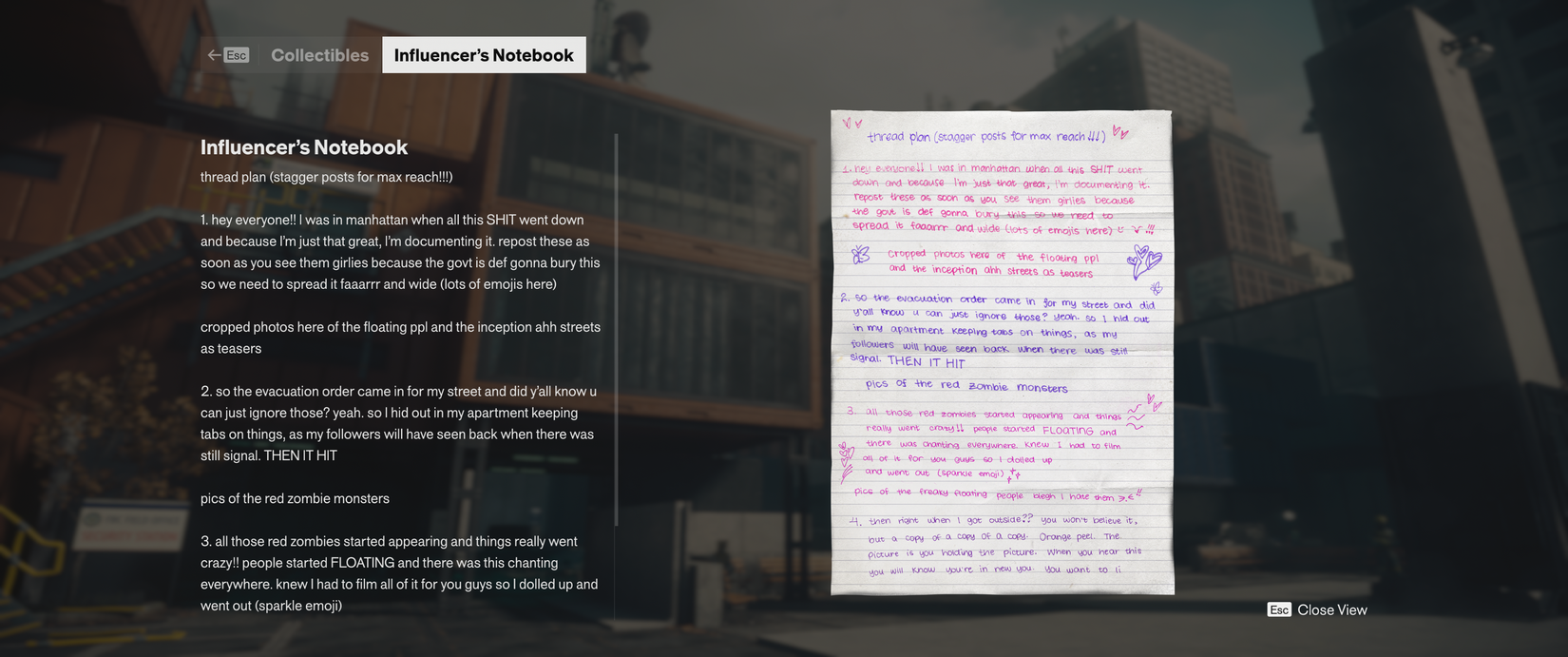 Image: Remedy Entertainment via Polygon
Is any of this a deal-breaker? Not really. It’s firmly in the nitpick category, considering that all the lore is optional, and you can choose to engage with it anytime you want. But it does wind up feeling like Resonant is overreliant on a tell-don’t-show approach to storytelling that hurts the pacing of a game built around fluid movement and action. On top of that, the glut of logs feels less narratively harmonious as they did in Control. That game, which was largely about the inner machinations of a government agency, was set in an office building. Naturally, paperwork would be lying around everywhere. The fact that you could find sensitive secrets hanging out on a table helped build the idea that the FBC were, perhaps, playing things a bit too loose. Resonant is far less about FBC politics and more focused on a sibling story between Jesse and Dylan. All that loose paperwork distracts from that heart.
While Resonant goes a little overboard, lore floods aren’t a Remedy-specific trait. It’s a fashionable design choice that pops up in everything from compact games like Pragmata to open-world behemoths like The Blood of Dawnwalker. When used sparingly, they can give a world more color and make it feel lived in. (See the entire Resident Evil series as a great example.) But it can just as easily be a momentum killer in action games like Marvel’s Wolverine that repeatedly force you to put down the controller for a minute or two to watch Logan stand in place and listen to a tape recorder. It’s not exactly the most exciting way to hear a story in a game.
I’m not advocating for less worldbuilding here; I just wish there were other ways to achieve it that were more integrated into play. Call me old-fashioned for loving trusty environmental design, but I love when I can infer a story in a world without having it spelled out to me. In fact, that’s what I love about the real Manhattan that Resonant’s city draws on. I can’t tell you how many times I’ve stumbled into the weirdest sight I’ve ever seen and walked away completely bewildered, stuck with an unsolved mystery that haunts me for years to come. Never be afraid to tell me less.