Novel marine monitoring network could help improve environmental protections, shipping regulations
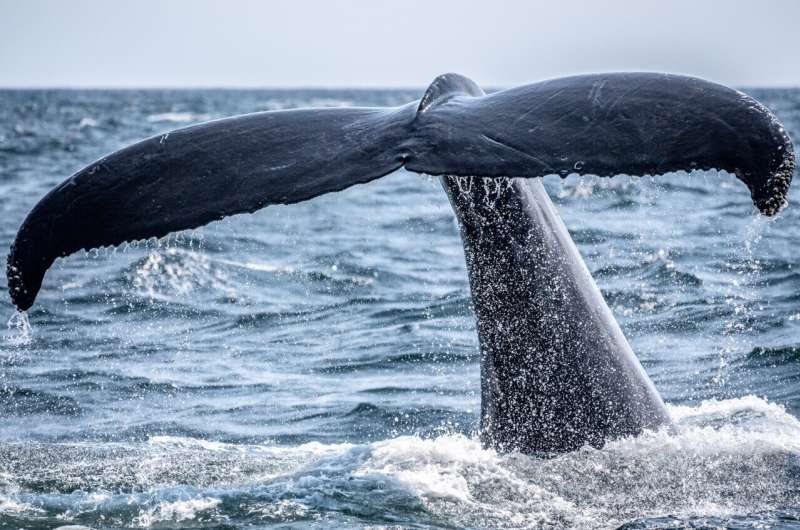
A single monitoring network developed by McGill, Natural Resources Canada, Université du Québec à Montréal (UQAM) and Dalhousie University researchers can simultaneously track earthquakes, water behavior, human activity and whales, providing a comprehensive picture of what's happening in, under and far from the water. The research is published in the journal Seismica.
The researchers' experimental network, installed in Lower St. Lawrence, detected twice as many earthquakes as the National Earthquake Monitoring System, while also capturing whale calls, ship noise, tidal activity and mining blasts.
The system combines tools known as "ocean bottom seismometers" from the National Facility for Seismological Investigations with coastal and land-based stations to monitor activity across the estuary.
The researchers said the results show how a single network can capture multiple types of data, with potential applications for conservation and marine policy.
"The Lower St. Lawrence is one of the most active seismic zones in Eastern Canada," said Yajing Liu, a professor in McGill's Department of Earth and Planetary Sciences and the study's lead author. "It's also a busy shipping corridor. That's a concern for whale habitats because some of the shipping noise can interfere with whale calls."

Separating sounds by frequency
The team deployed ocean-bottom seismometers, land stations and coastal stations in the river's estuary area between Rimouski and Sept-Îles. The network was in place from September to May between 2023 and 2025, avoiding the summer fishing season to prevent damage to the instruments from trawling. The sensors recorded continuously at 250 data points per second.
Using spectral analysis, the researchers separated different types of signals by frequency.
"When you look at a single day of data, you can see whale calls and ship traffic at the same time and place," Liu said. "That suggests ship noise may be interfering with whale communication."
When the team compared its dataset with the national monitoring system, it found the network detected roughly twice as many earthquakes, along with several shallow blast events.
Not just background noise
Liu added that the instruments also picked up clear signals tied to tidal activity.
That information could help improve ocean circulation models, which are typically based on surface measurements. It may also shed light on whale activity. While conditions at the bottom of the water column are less well understood, they are closely linked to whale behavior as nutrient-rich currents shape feeding and migration patterns.
One system, multiple benefits
The project builds on earlier work by Liu's team using land-based seismometers, which found whale calls increased during winter months. However, the estuary's width—up to 100 kilometers (62 miles) in some places—meant some signals were getting lost.
"Putting sensors on the riverbed gave us much better coverage to map whale activity," Liu said.
The team said the system could inform environmental protection efforts and marine traffic regulations in one of Canada's busiest waterways.
"The advantage is that one dataset can serve multiple purposes," Liu said. "We're able to observe earthquakes, ocean conditions and marine life at the same time."
More information
Yajing Liu et al, Lower St. Lawrence Seaway Amphibious Seismic Network for earthquakes and marine soundscape monitoring, Seismica (2026). DOI: 10.26443/seismica.v5i1.2044
Who's behind this story?

MA in English, copy editor since 2021 with experience in higher education and health content. Dedicated to trustworthy science news. Full profile →

Master's in physics with research experience. Long-time science news enthusiast. Plays key role in Science X's editorial success. Full profile →
Citation: Novel marine monitoring network could help improve environmental protections, shipping regulations (2026, July 9) retrieved 12 July 2026 from https://phys.org/news/2026-07-marine-network-environmental-shipping.html
This document is subject to copyright. Apart from any fair dealing for the purpose of private study or research, no part may be reproduced without the written permission. The content is provided for information purposes only.