Resident Evil Meets Little Nightmares in Terrifying New Horror Game
Follow
Link copied to clipboard

Published Sep 30, 2026, 10:00 AM EDT
End of Abyss makes you feel like a lost child in a menacing labyrinth
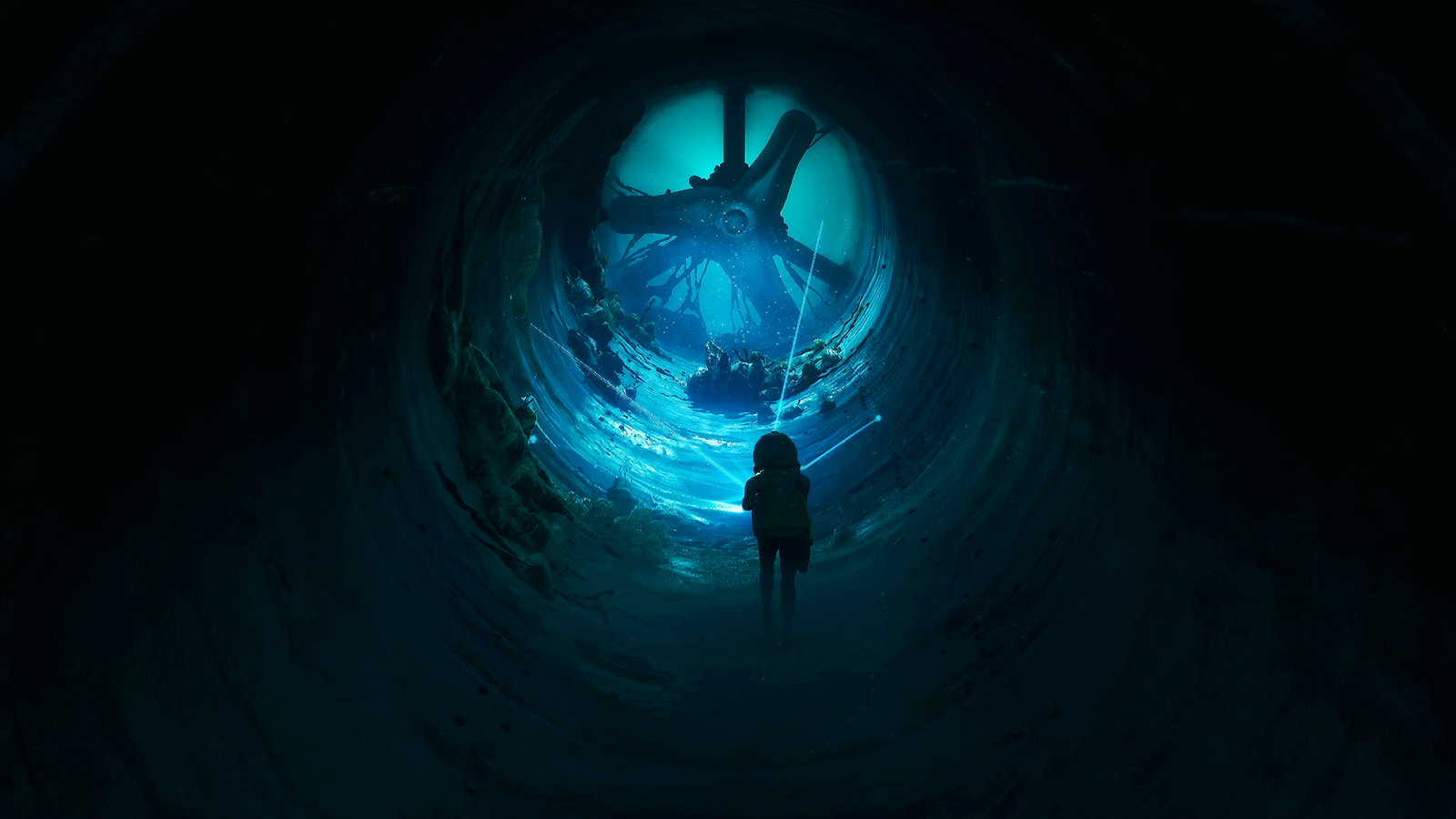 Image: Section 9 Entertainment/Epic Games
I’m small and I’m lost. For nearly a decade, that sinking feeling has haunted Bandai Namco’s Little Nightmares series. Created by Tarsier Studios (the team behind this year’s fantastic Reanimal), Little Nightmares first caught fire in 2017 because it captured a very real kind of terror — one you feel as a kid anytime you get separated from your guardian in an unfamiliar place. Section 9 Interactive, a studio founded by former Little Nightmares developers, has now taken that idea to its logical evolution for its debut game, End of Abyss. Can any video game genre leave you feeling as small and lost as a Metroidvania?
Combining the eerie atmosphere of Little Nightmares with the thrills of a ‘90s sci-fi horror flick, End of Abyss delivers an unnerving descent into a blue-toned hell. It invites obvious comparisons to James Cameron’s The Abyss, but it's more comparable to getting lost in an empty mall at night as a child. Your bobble-headed hero is so tiny, and the steel around them seems to stretch on forever. Messy execution doesn’t do that promising premise justice, but End of Abyss occasionally sticks in your gut as a nerve-racking tone piece crawling with parasites.
End of Abyss stars Cel, a technician who is part of an expedition to an abandoned underground facility. My instinct is to describe Cel as pint-sized, but I’m not actually sure they are. Section 9 Interactive plays with perspective at every turn to make you feel as small as possible. Your crew mates, decked out in bulky gear that makes them look like Warhammer marines, tower over your puny frame. The top-down camera makes you look like a speck in wide-open rooms. Metallic walls seem to stretch out to infinity. There’s an immediate sense of unease baked into End of Abyss that presents itself well before you encounter your first monster.
Section 9 Interactive is smart to never explain too much as to ruin an unknowable mystery. It’s never entirely clear what the structure is or what plague has overtaken it. A bit of dialogue between crew mates and some scattered text logs give you just enough to grasp the situation while keeping the scary details in the dark.
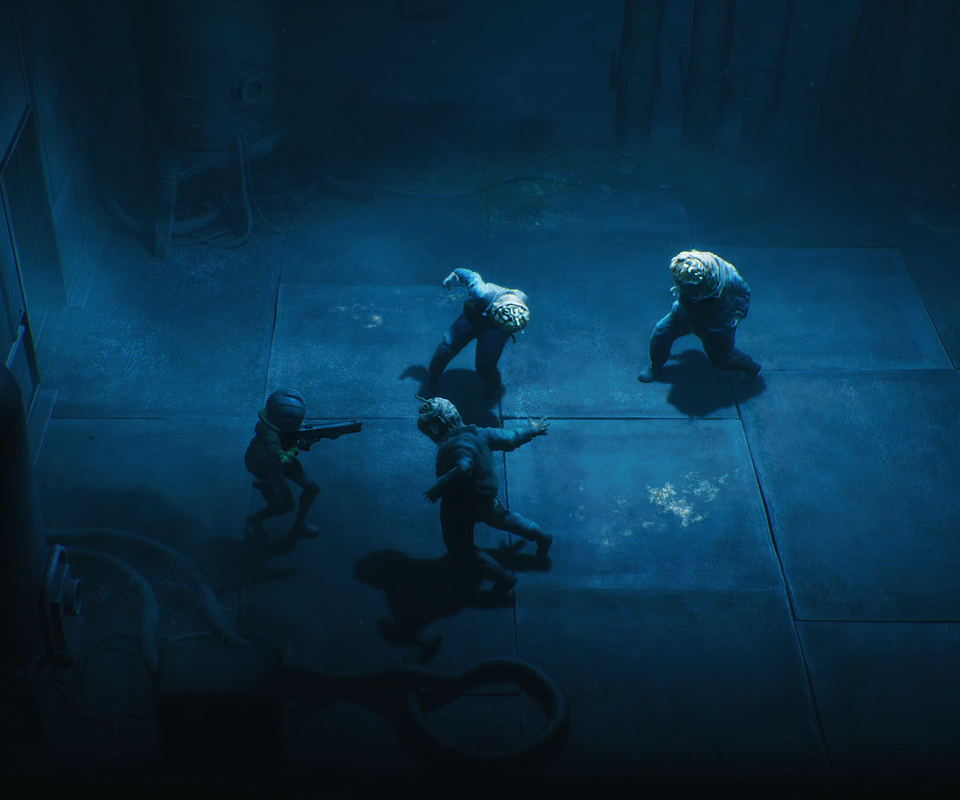

And darkness is instrumental to End of Abyss’ Metroidvania exploration. The story’s true main character is the structure you’re dared to explore, a metallic tomb awash in dark blue light. It’s impossible to tell where the little light you have is even coming from; every precious ray clings to the reflective steel of twisted sewer drains and crumbling catwalks. Cel can light flares to help guide them, but their violent burn amid the stillness of the structure almost makes matters more terrifying. It feels like you’re drawing the full attention of the dead on Cel every time you dare to use one.
End of Abyss wants you to get hopelessly lost in it, which isn’t new for the Metroidvania structure it's working in. The appeal of the genre has lived in the way it throws players into a map that seems never-ending and dares them to poke into every corner until they find a wall. It’s a strong setup for a horror game like this, one that sends you into the unknown looking for key cards and abilities that can help you unravel more of the puzzle box.
Its minimalistic world is both towering and claustrophobic, a contradictory combination that requires skill to pull off.
It’s not surprising that a team founded by former Little Nightmare developers would nail that tone, but it’s also not surprising that it wouldn’t have the firmest handle on Metroidvania design in its debut. After all, the Little Nightmares games largely deal in linear design that takes players through uninterrupted nightmares operating on surreal logic. End of Abyss calls for a more intricate kind of design as hallways and ladders create unexpected shortcuts in an interconnected structure. That space can be frustrating to navigate thanks to a visual consistency that makes it hard to tell where you are, and a 2D map that struggles to communicate the depth and criss-crossing pathways of the spaces you’re exploring.
It didn’t help that the version of End of Abyss I played was notably buggy, too. When I wasn’t struggling with visibility, I was accidentally clipping into a wall and falling through the map or butting up against interactable objects that weren’t responding correctly. (I even suspect that I got to the ending of the game earlier than I was meant to, bypassing most of the exploration in the final area and accidentally winding up in the final boss room too early.) The obvious issues will no doubt be smoothed over in patches, but they do reinforce a rushed feeling found in the world design.
Similarly, End of Abyss finds mixed results as an action game. The genre twist here is that you’re playing a twin-stick shooter where you need to pivot Cel around to line up zombie-like monsters and fire at them. It’s another strong design decision conceptually; it feels like a natural evolution of old-school Resident Evil shooting. You need to plant your feet and fire as long as you can, playing chicken with an approaching monster. Can you gun it down before your rechargeable pistol energy runs out, or before it lunges at you? That risk factor makes for some sweat-inducing combat early on.
 Free sign-up
Get Polygon’s Wishlister newsletter
A weekly cheat sheet to what you’ll eventually love to play. No buying, no commitment — just saving for later.
Sign up free
Free. Unsubscribe anytime.
The action never quite gets deep enough to support a 10-hour game, though. Once I found my rhythm, combat began to feel like a mechanical process I needed to get out of the way to keep moving. The surprise of getting jumped by a well-hidden monster in the shadows loses its thrill when it respawns every time you die, and you know exactly where to stand to deal with it. Additional weapons with limited ammo, like shotguns, and grenades help drive up some tension with a bit of resource scarcity, but it never felt like I needed any extra firepower outside of my pistol to get the job done. And if I did, I was always flush with resources that would let me craft as much as I needed in a safe room.
Strong atmosphere only goes so far to carry a sometimes ho-hum Metroidvania, but Section 9 Interactive still effectively taps into a primal sort of fear in its commendable debut. Its minimalistic world is both towering and claustrophobic, a contradictory combination that requires skill to pull off. With no sense of space, time, or place, End of Abyss does a great job of convincing you that there are no exits in its structure. It feels like drowning under a sheet of ice, desperately looking for a hole to poke your head out of. Or, more familiarly, it feels like getting lost in a Kohl’s at 6 years old. The coat racks stretch above your head like skyscrapers, and the racks of jeans stretch out for miles. There’s no chance for a child that small to escape the labyrinth; all you can do is sit down and cry loud enough in hopes that mom comes to the rescue.
End of Abyss will be released Oct. 1 on PlayStation 5, Windows PC, and Xbox Series X. The game was reviewed on PlayStation 5 Pro using a prerelease download code provided by Epic Games. You can find additional information about Polygon’s ethics policy here.