Ukraine persists with Russian oil refinery strikes in defiance of Trump
Ukraine is pressing on with strikes on Russian oil refineries, defying Donald Trump, who blames the attacks for exacerbating a global diesel shortage and pushing up fuel prices.
Kyiv struck an oil facility in Russia’s southern Samara region overnight, Volodymyr Zelenskyy said on Thursday in a statement on social media. The Ukrainian president added that a Russian vessel in the Black Sea was hit, as well as a launch and storage site for attack drones in the Oryol region.
Trump has urged Zelenskyy in a private phone call to halt attacks on Russian refineries and repeatedly suggested in public that Ukraine’s strikes are to blame for the squeeze on global fuel supplies. “Diesel is really hurt much more, not by the Middle East, but by what’s going on in Russia, because those diesel refineries are being knocked out at a pretty alarming rate,” Trump said on Wednesday.
Diesel prices in the US have risen to record highs in recent weeks, adding to cost of living pressures that have helped push Trump’s approval ratings to a career low before next month’s crucial midterm elections.
Energy analysts, however, have pointed to the war in Iran and wider disruption to global oil markets as the leading drivers of the price increases.
Ukraine’s long-range strikes on Russian refineries have nevertheless emerged as an additional headache for Trump, with the attacks also contributing to tighter diesel supplies at a politically sensitive moment for the US president.
Ukraine’s campaign in recent months has knocked out more than 45% of Russia’s refining capacity, according to Ukrainian estimates, prompting fuel rationing in some regions and long queues at petrol stations.
The Ukrainian president on Thursday also said the FP-7 tactical ballistic missile, which has a range of 200km and was developed by the Ukrainian defence firm FirePoint, had been deployed for the first time. Zelenskyy accompanied the statement with footage of a missile launch, but did not disclose when or where the weapon had been used.
Speaking at the Valdai discussion club, Vladimir Putin on Thursday acknowledged that Ukrainian strikes on Russian oil refineries had cost the country roughly 1% of its GDP.
Earlier this week, Russia – traditionally the world’s second-largest diesel exporter – extended its ban on diesel exports until the end of October, adding further pressure to a global supply crunch.
Mykola Bielieskov, a military analyst at Ukraine’s government-run National Institute for Strategic Studies, said it was unlikely Kyiv would stop targeting Russian oil infrastructure as long as Moscow continued its daily attacks on Ukraine. “There is no rationale for Ukraine to continue exercising restraint while it is being bombarded and major urban areas are under constant attack,” he said.
“We need to deprive Russia of revenue,” he added.
Zelenskyy has been pushing for a US-brokered energy ceasefire with Russia, but Putin has shown little interest in the proposal, instead vowing to intensify strikes on Ukraine.
At Valdai, Putin called “absurd” a proposal he said was be discussed, under which Russia would stop striking Ukrainian vessels if Ukraine halted attacks on Russian oil refineries.
In wide-ranging comments at the forum, Putin said Moscow was not on the verge of attacking foreign factories producing weapons for Ukraine, but that such facilities were something Russia’s military and intelligence services needed to monitor closely.
He also ramped up his nuclear rhetoric, warning that Russia would consider using “all types of weapons” if its exclave of Kaliningrad was attacked, while insisting that Moscow had “no intention of attacking anyone”.
Tensions over the exclave have risen this week, with Russia previously sending a letter to Nato warning it would be ready to resort to using nuclear weapons if the western alliance attempted to cut off Kaliningrad.
Meanwhile, Russia has continued its deadly missile and drone strikes on Ukrainian cities, targeting energy infrastructure, commercial warehouses and other businesses in an apparent effort to cripple the country’s economy and render Kyiv increasingly uninhabitable.
A Russian drone struck a school in Kyiv on Thursday morning, but no one was injured because the children were sheltering in the basement, mayor Vitali Klitschko said.
A key bridge in the Ukrainian capital was also hit, forcing authorities to suspend metro services and other public transport.
Kyiv has experienced near round-the-clock Russian attacks in recent weeks, at times increasingly resembling a frontline city in what many see as the most challenging period for the capital since the early days of the full-scale invasion.
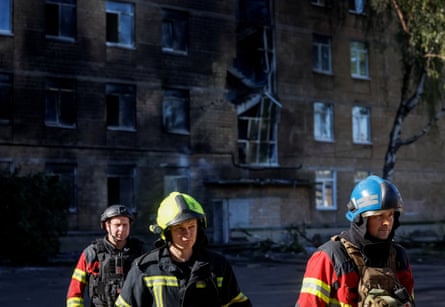
Russia’s newer jet-powered drones have proved particularly difficult for Ukrainian air defences to intercept, with success rates significantly lower than for the slower Shahed-type drones.
The sustained attacks have revived fears of another winter with prolonged power and heating outages, after similar strikes last year left parts of Ukraine without electricity during temperatures that fell as low as -20C (-4F).