Putin says ‘all weapons at disposal’ if there’s an attack on Russia – as it happened
From
2h agoRussia's Putin confirms 'all weapons at disposal' in case of attack on Russia, but says it would not attack first
In the Q&A after his speech, Russia’s Putin also got asked about Moscow’s widely reported nuclear threat over Kaliningrad (Europe Live, yesterday).
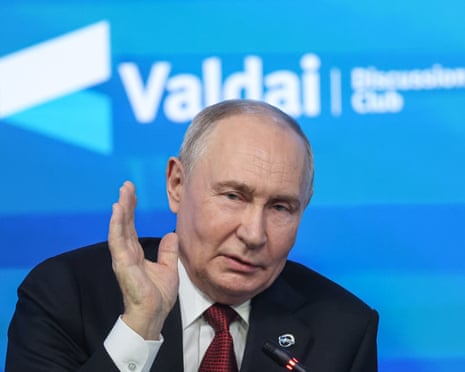
Putin confirms that Russia issued a statement and letters to some embassies on this point.
But he claims:
“This is not us threatening, but this is a response to attempts to threaten us.”
He continues:
“These statements, statements by the western politicians and European politicians about the need and possibility and preparation for the war with Russia in 2029 and 2030.
It’s not us saying these words, but we hear it from the other side, constantly.”
He eventually confirms that “if it comes to a direct attack on the Russian Federation – in this case we mean Kaliningrad, but may be some other territories as well – of course, naturally, immediately what will be on the agenda is the use … of all weapons that we are the disposal of our country.”
He says that with Nato a potential adversary “exceeding us,” Russia would not have “many means to counter such a threat,” and would need to use its “competitive advantages.”
But Putin says that the risk of using nuclear weapons is only serious if Nato’s threats against Russia are serious.
And then he goes on a rant about taking his words out of context, so let’s quote him in full:
“I think that this constant increased tension by many European countries; it has to do with a great deterioration of economic and domestic political situation in the countries. Look at their economy, what’s happening in terms of social policy and living standards of citizens in major European countries. Amid such conditions, they have to shift the focus of attention of their citizens from domestic issues towards outside issues.
Now, I have to respond to the questions that you asked me, and I think that they were waiting for us to respond.
Right now, they will cut it out of context, and they will abuse and exploit this notion that Russia is threatening us with nuclear weapons to distract the attention of their citizens from the fact that they are conducting their own aggressive policy against Russia, that they’re pushing their citizens towards a dangerous line towards confrontation against Russia.
We’re not threatening anyone. We do not intend to attack anyone in 2029, in 2030, in 2050, but if we come across an aggression, we will have to respond.
The citizens of the European countries should be fully aware of that and make the distinction between our position and the position of incumbent governments of their countries.”
Curiously, a moment later, he also appears to play down tensions a bit as he says “I do not think we are going to conduct strikes on the territory of countries procuring weapons for Ukraine, but this is a threat, and we are monitoring it closely.”
Key events
2h ago
Closing summary
2h ago
Russia's Putin confirms 'all weapons at disposal' in case of attack on Russia, but says it would not attack first
2h ago
Putin says conflicts likely to continue and Russia was 'forced' into war in Ukraine
2h ago
Europe 'not at peace today' amid growing Russian malign hybrid attacks, Nato chief warns
3h ago
Germany preparing for 'major hybrid attacks' and ready to respond 'swiftly,' chancellor Merz says
4h ago
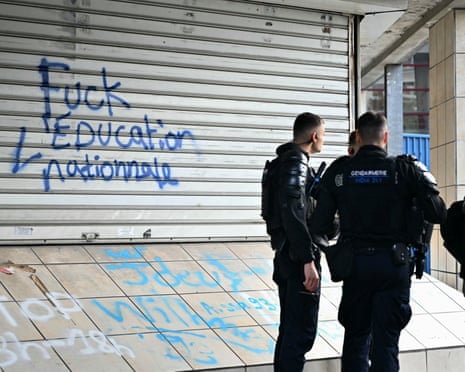
French high school protests escalate with reported violence
4h ago
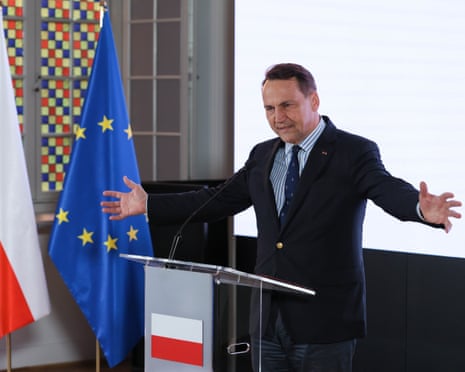
Sikorski says Poland would welcome Britain back to EU 'with open arms'
5h ago
Ukraine made net gains in September with counteroffensive push against Russia
5h ago
Joint EU–Ukraine statement says they have 'identified means' on budget shortfall
5h ago
Finland investigates suspected break-ins at MPs homes
5h ago
A determined show of unity amid growing tensions with Russia - snap analysis
6h ago
'I hope Putin gets the message' as he is 'failing to intimidate us,' Rutte says
6h ago
'We see Russia testing us across Europe,' and 'must be prepared for hostile actions,' Nato chief says
6h ago
Russia 'poses rapidly increasing threat' to Nato, Dutch PM says
6h ago
Russia's 'violent revisionism' challenging Europe's peace, Merz warns
6h ago
Russian drone hits grounds of nuclear research facility in Kyiv
6h ago
Rutte, Merz, Jetten about to speak at joint press conference in Germany
6h ago
Germany's Jürgen Klopp disgusted by claims national team are ‘not white enough’
7h ago
EU countries, Britain hold call on possible release of reserve diesel stacks
7h ago
Kyiv Independent editor: ‘Our readers want Russia to suffer but we can’t be propagandists’
8h ago
Two Russian drones hit a major bridge in Kyiv
8h ago
Russia expels Hungary's diplomats in retaliation to Budapest's move earlier this month
9h ago
UK adopts new sanctions on Russia over Ukraine war
9h ago
Russian drone hits school in Kyiv
9h ago
Ukraine hits oil facility in Russia's Samara region despite pressure from Trump
10h ago
Italy, Poland extend suspensions of Schengen rules to fight irregular migration
10h ago
Estonia bans transit of Russian, Belarusian grain through its territory
10h ago
Morning opening: Russia continues strikes on Ukraine as Zelenskyy makes a frontline visit
Closing summary

Jakub Krupa
And, on that note, we will be closing the blog for today.
-
Russian president Vladimir Putin repeated his threat of using “all weapons at disposal” against any perceived aggression against Russia, as he falsely insisted that Russia was “forced” to attack Ukraine and faces further provocation from Nato (18:05, 18:25).
-
Nato’s secretary general Mark Rutte has warned that “Europe is not at peace today,” as it faces a “full-blown war” in Ukraine and “growing” list of Russian malign hybrid attacks on the continent (17:44).
-
German chancellor Friedrich Merz has said Germany is “preparing for major hybrid attacks, including severe ones,” and would respond “swiftly and very clearly,” as he repeated his warning that “the coming months will be momentous for the fate of Ukraine and for the security of Europe.” (17:35).
-
Separately, Finnish authorities are investigating a slew of suspected break-ins at the homes of members of parliament, which the prime minister said could “very likely” be linked to a foreign power (14:45).
Elsewhere,
-
France’s prime minister convened a crisis meeting on Thursday and cancelled ministers’ trips to focus on the nationwide spread of protests, some violent, by high school students venting against under-resourced schools (16:20, 16:32, 16:47).
If you have any tips, comments or suggestions, email me at [email protected].
I am also on Bluesky at @jakubkrupa.bsky.social and on X at @jakubkrupa.
Russia's Putin confirms 'all weapons at disposal' in case of attack on Russia, but says it would not attack first
In the Q&A after his speech, Russia’s Putin also got asked about Moscow’s widely reported nuclear threat over Kaliningrad (Europe Live, yesterday).
Putin confirms that Russia issued a statement and letters to some embassies on this point.
But he claims:
“This is not us threatening, but this is a response to attempts to threaten us.”
He continues:
“These statements, statements by the western politicians and European politicians about the need and possibility and preparation for the war with Russia in 2029 and 2030.
It’s not us saying these words, but we hear it from the other side, constantly.”
He eventually confirms that “if it comes to a direct attack on the Russian Federation – in this case we mean Kaliningrad, but may be some other territories as well – of course, naturally, immediately what will be on the agenda is the use … of all weapons that we are the disposal of our country.”
He says that with Nato a potential adversary “exceeding us,” Russia would not have “many means to counter such a threat,” and would need to use its “competitive advantages.”
But Putin says that the risk of using nuclear weapons is only serious if Nato’s threats against Russia are serious.
And then he goes on a rant about taking his words out of context, so let’s quote him in full:
“I think that this constant increased tension by many European countries; it has to do with a great deterioration of economic and domestic political situation in the countries. Look at their economy, what’s happening in terms of social policy and living standards of citizens in major European countries. Amid such conditions, they have to shift the focus of attention of their citizens from domestic issues towards outside issues.
Now, I have to respond to the questions that you asked me, and I think that they were waiting for us to respond.
Right now, they will cut it out of context, and they will abuse and exploit this notion that Russia is threatening us with nuclear weapons to distract the attention of their citizens from the fact that they are conducting their own aggressive policy against Russia, that they’re pushing their citizens towards a dangerous line towards confrontation against Russia.
We’re not threatening anyone. We do not intend to attack anyone in 2029, in 2030, in 2050, but if we come across an aggression, we will have to respond.
The citizens of the European countries should be fully aware of that and make the distinction between our position and the position of incumbent governments of their countries.”
Curiously, a moment later, he also appears to play down tensions a bit as he says “I do not think we are going to conduct strikes on the territory of countries procuring weapons for Ukraine, but this is a threat, and we are monitoring it closely.”
Putin says conflicts likely to continue and Russia was 'forced' into war in Ukraine
Meanwhile, Russia’s Vladimir Putin warned that international conflicts were highly likely to continue as the world changed, but that the situation would get better as what he called western hegemony waned, Reuters reported.
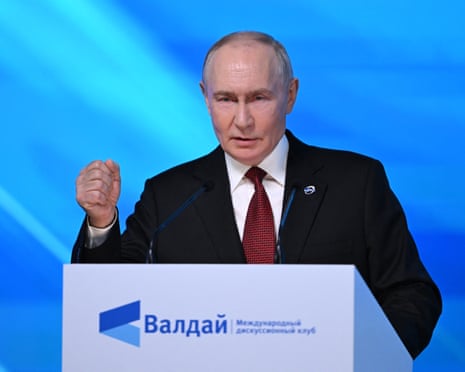
“Regardless of which scenario unfolds globally in the coming years, the continuation of international conflicts is, unfortunately, highly likely. This is due in part to the fact that ongoing fundamental shifts – and the opportunities they present – fuel ambitions and a willingness to take risks for the sake of a seemingly massive payoff,” he said.
During his speech Putin also repeatedly denied any responsibility for starting the war in Ukraine, saying it was “started against us,” with “aggressive nationalism and Russophobia“ and Nato’s expansion eastwards into “our historic territories.”
“Russia was simply forced to respond to this apparent aggression,” he falsely claimed.
Putin also lamented “the logic of escalating mutual, tough responses” turning into “a fatal inevitability” of “devastating consequences.”
“Leading countries of the world have their disposal armaments that can wipe away all life, or at least push the earth to catastrophic consequences. Can we be certain that this weapons will never be used? Unfortunately, we cannot be sure.
There’s this famous statement: if there is a gun hanging on the stage at the beginning of a show, it’ll certainly fire by the end.”
Europe 'not at peace today' amid growing Russian malign hybrid attacks, Nato chief warns
Nato’s Mark Rutte warned that “Europe is not at peace today,” as it faces a “full-blown war” in Ukraine and “growing” list of Russian malign hybrid attacks on the continent.
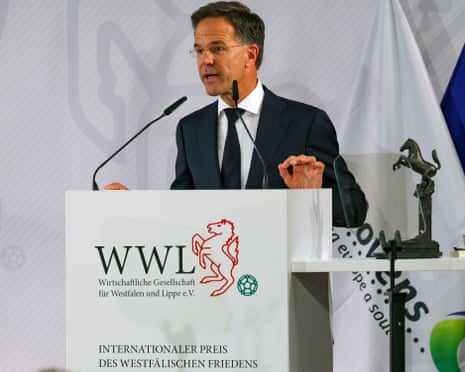
In his acceptance speech at the 2026 International Westphalian Peace Prize Award Ceremony, he said:
“Despite those heavy losses, Putin shows no willingness to bring the war to an end. If anything, at the moment he is intensifying it.
And let’s be clear: our own nations are targets. The list of Russia’s malign hybrid attacks across Europe grows longer every day.
Cyber-attacks, sabotage, arson, airspace violations, drone incidents – indeed, at Leipzig Airport, a drone with explosives attempted to blow up cargo planes.
We know these attacks are a sign of desperation in Russia. Putin is not getting his way in Ukraine and wants to make us pay for it.
…
Putin wants to intimidate and divide us, but he will fail. And our response to his hostile actions is to support Ukraine even more.”
Rutte hailed Merz’s decision to ramp up defence spending last year, saying historians would be kind to his determination to make it happen.
But Nato chief also warned that European leaders are “in for a long journey,” as “Russia’s well-oiled war machine is not going to turn rusty anytime soon, and … China’s military modernisation and technological development are not about to slow down.”
He added:
“Peace is precarious. We do not know, with certainty, what tomorrow will bring. But we do know we will defend one another, and attack against one is an attack against all. This credo and our steadfast resolve to live by it, has preserved peace for over 75 years.”
Germany preparing for 'major hybrid attacks' and ready to respond 'swiftly,' chancellor Merz says
German chancellor Friedrich Merz has said Germany is “preparing for major hybrid attacks, including severe ones,” and would respond “swiftly and very clearly.”
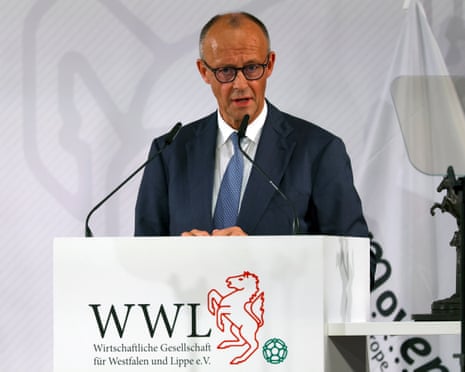
The embattled chancellor said the growing number of incidents came amid Russia’s “growing perplexity” at its “unsuccessful conduct of the war in Ukraine.”
He said it’s “important that we refuse to be intimidated by cyberattacks, drones, and online propaganda.”
Merz repeated his warning that “the coming months will be momentous for the fate of Ukraine and for the security of Europe.”
Jakub Krupa
Two things are happening at the same time now: over in Münster, Germany’s Friedrich Merz is presenting Nato – embodied by its secretary general Mark Rutte – with the 2026 International Award Ceremony of the Peace of Westphalia. We will hear from both of them.
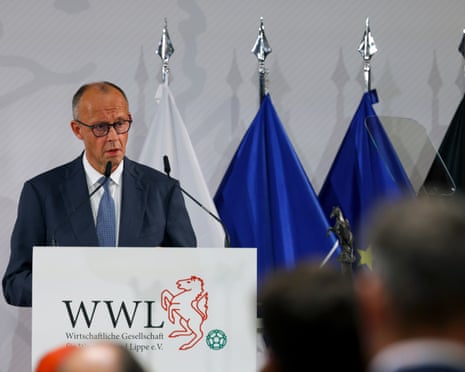
Meanwhile, Vladimir Putin is speaking about Russia’s foreign policy aims at the Valdai Discussion Club.
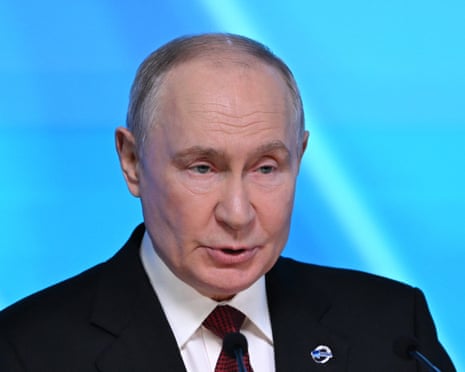
I will bring you key lines from all three speeches.
AFP reported that some 340 demonstrations were underway late morning, with police forces deployed to several schools.
University students joined in on Thursday, blocking physical access to around 30 campuses, including in Paris and the southern city of Marseille, a student union said.
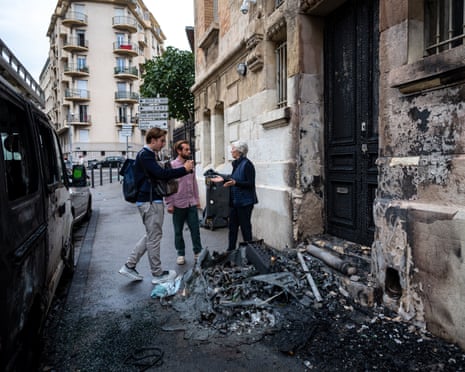
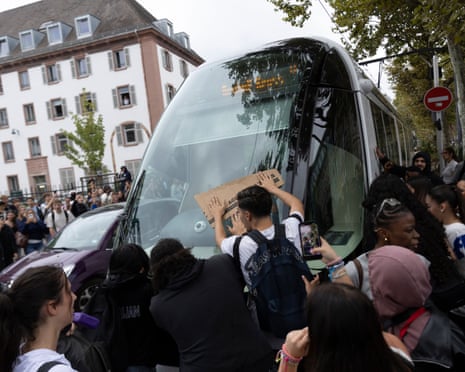
In the northeastern city of Strasbourg, authorities ordered trams to grind to a halt to “restrict the movements of rioters and demonstrators”, the regional prefect said.
In the northern city of Lille, AFP reporters saw young people wearing black hoodies destroy the glass of a bus stop. Firefighters intervened to put out the flames on upturned dustbins set on fire.
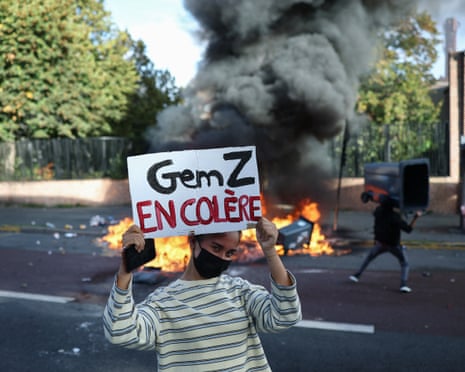
What started as a nationwide student protest over the state of the French education system has now descended into full-blown “urban violence”, according to government officials, who briefered the media, including BFMTV and Le Figaro.
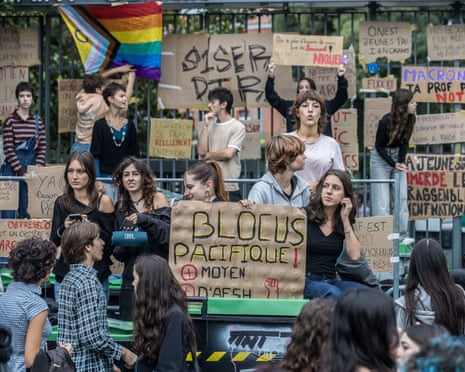
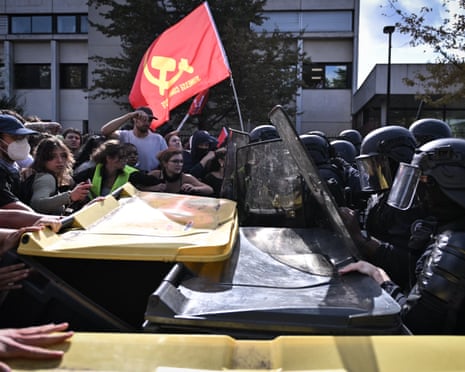
The authorities believe the protests and riots are supported by far-left groups, who seek to sow discord.
In public comments, education minister Édouard Geffray called the reported violence “extremely serious,” and saying they cannot be justified in any way.
Justice minister Gérald Darmanin has called a meeting with all regional prosecutors for later this evening to discuss their response.
But the far-left France Unbowed party’s coordinator, Manuel Bompard, rejected the accusations as “conspiracy theories.”
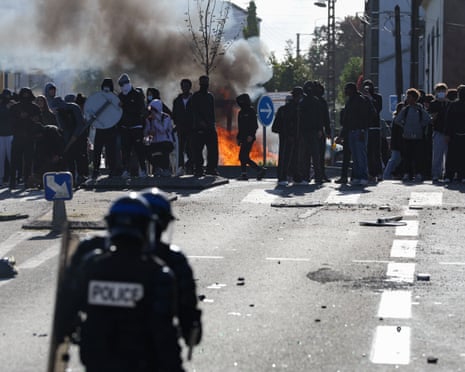
French high school protests escalate with reported violence
France‘s prime minister convened a crisis meeting on Thursday and cancelled ministers’ trips to focus on the nationwide spread of protests, some violent, by high school students venting against under-resourced schools, long hours and other complaints, AP reported.
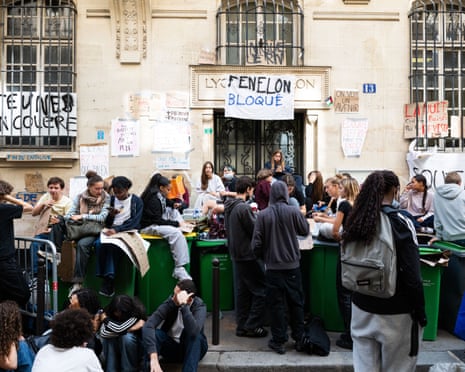
The demonstrations erupted in Paris-region schools last week and have snowballed, with police making hundreds of arrests in clashes with the young protesters.
Authorities have reported many dozens of injuries, including from hurled objects but also, in some suspected cases, from police riot-control projectiles.
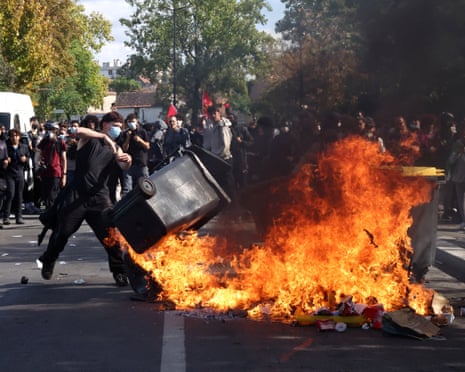
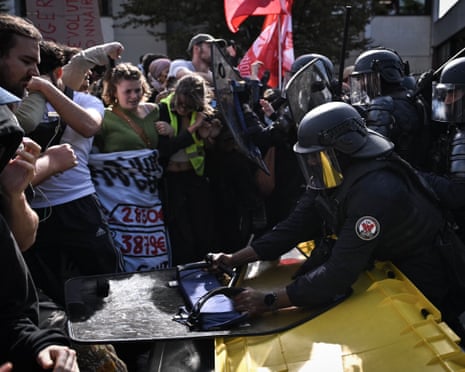
The protests are quickly blowing up as a hot topic in the election campaign to replace president Emmanuel Macron next May and heightening pressure on the government also beset by France‘s growing financial problems.
The office of prime minister Sébastien Lecornu said he asked ministers to cancel any planned official trips in the coming days, to enable authorities and police to focus on dealing with the demonstrations.
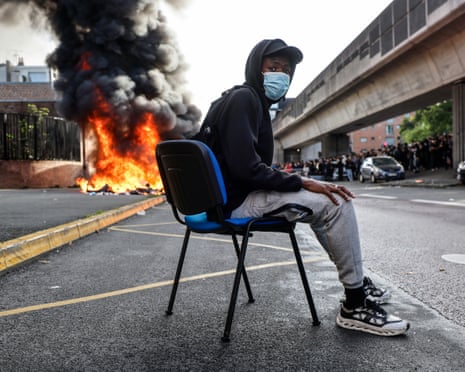
Sikorski says Poland would welcome Britain back to EU 'with open arms'
Jakub Krupa
After France’s Emmanuel Macron and Spain’s Pedro Sánchez yesterday, Poland’s foreign minister Radosław Sikorski is the latest EU leader to offer his take on Britain’s renewed push to reset its relationship with the European Union, a decade on from Brexit.
In a post on X aimed partially at his domestic opponents ahead of Poland’s 2027 parliamentary election, he said:
“If [Britain] were to apply for a return to [the EU], which Poland would welcome with open arms, it would mean that after a decade of analyses, London has concluded that membership is the optimal form of participation in the single market.
Let us not be swayed by the Europhobes into believing that a better alternative exists.”
Ukraine made net gains in September with counteroffensive push against Russia
Ukrainian troops have regained ground in a counteroffensive in the Donetsk region, according to an AFP analysis of data from the Institute for the Study of War (ISW).
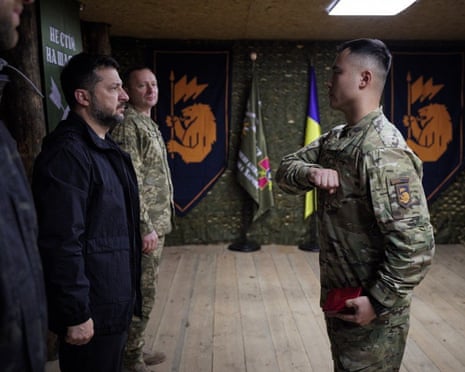
Operation “Vivaldi” was launched in September with the aim of pushing Russian forces back from the cities of Sloviansk and Kramatorsk.
The Ukrainian military has retaken small patches of territory from Russia, for total gains in the Donetsk region of 172 square kilometres (66 square miles), an area more than 1.5 times the size of Paris.
Elsewhere, Ukraine retake small areas in the regions of Kharkiv in the north (seven square km) and the eastern regions of Dnipropetrovsk (12 square km) and Luhansk (13 square km).
By contrast, Russian offensives in Zaporizhzhia (south) and Sumy (north) enabled Kremlin forces to seize 104.5 square km and 20 square km respectively.
Overall, Ukraine made a net territorial gain of 80 square km in September, according to the data.