What Not To Say At The Dealership When Negotiating A Car's Price - Jalopnik

Goran13/Getty Images
Some people hate negotiating. Car dealers know this, which is why some capitalize on it by branding their businesses as "no haggle" dealerships and act like they're doing you a favor by eliminating negotiation. What they really mean by doing that is, "You'll pay what we tell you to pay, and you'll like it." But you need not fear the haggle. Many dealerships expect you to negotiate, and are generally happy to do it with you. Done right, it can be a perfectly polite and civil conversation, even if you don't eventually agree on a price. But the secret to negotiating a deal that's good for you is not to give away leverage. Unfortunately, a lot of car shoppers do just that with certain things they say.
Some of the things you want to avoid doing early in the negotiation include telling the salesperson how much you can afford to pay monthly or that you already have your own financing. Have you saved enough to pay in cash? Great! Just don't let the dealer know that right away. You also don't want the dealer to know if you're desperate to get a car. Additionally, don't act too excited if you see the exact car you want. And don't reveal your trade-in until the end of the negotiation.
Don't reveal your monthly payment budget

Hispanolistic/Getty Images
Perhaps you don't have all the cash you need to pay upfront for a decent car without financing it. Few people do in this economy. So, you've figured out how much you can put down and how much you can afford in monthly loan payments. Great, keep that information to yourself at first, even if the sales rep asks about it. If you start the conversation with how much you can pay per month, the sales rep is not going to point you to an affordable car that you can pay off in 36 to 48 months by making your desired payments. No, they are likely to point you to a more expensive car, then work out a much longer loan for you (60 to 84 months) so that the payments are close to your target. That's not a good thing.
The longer your loan, the more you pay in interest, and the more likely it is that at some point you will owe more than what the car is worth. In fact, we reported on one guy who was $29,000 underwater on his car loan. Instead, if the salesperson asks what kind of payment you're looking for, tell them you're more interested in a total price before working out payments. Use an online auto loan calculator beforehand to figure out what the total price needs to be to get a payment you can afford, especially with new car prices getting out of hand today. Fun fact: The average car payment has reached a record-high $777 this year.
Don't say you're going to pay in cash

Hammarby Studios/Getty Images
So, maybe you do have the cash to pay for a car without financing, or perhaps you were smart and got preapproved for third-party financing before shopping for a car. Both of those things are good. If you pay in cash, you can avoid interest payments. There are arguments for both cash and financing, but if you have preapproved financing, you can compare that rate with the one the dealership offers you before making the decision. Keep in mind, dealerships make more money when they can finance the car to you, so they may be more eager to work out a better deal or offer discounts if they think they have a chance of providing the financing rather than selling the car to you for cash.
What should you do if you plan to pay in cash? If the sales rep presses you on it or asks if you plan to finance, tell them you want to work out the out-the-door price first, then you'll figure out whether you want to finance it. The out-the-door price is the total price, including taxes, tags, and fees. It's important to know that, even if you plan to finance, because those items will be included in the loan amount.
Don't reveal you want to trade in your car too soon
Jetcityimage/Getty Images
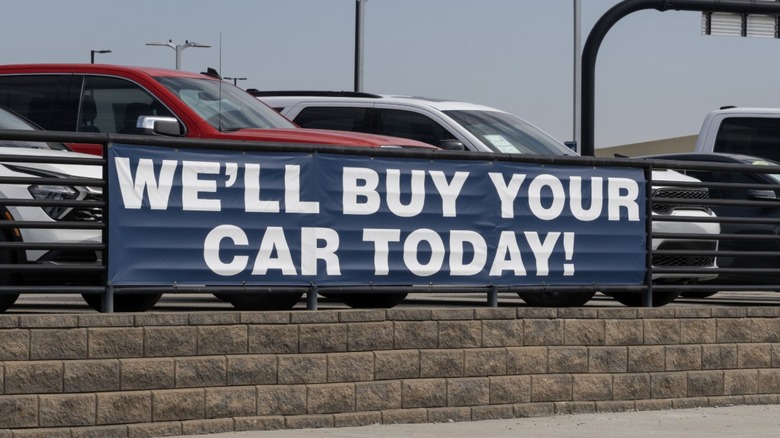
Negotiating at a car dealership is a little like playing poker — you need to keep your cards close to the chest and not show them until you're ready to play them. The fact that you want to trade in your old vehicle is one of those cards. A trade-in is a negotiating tool, but it should be your negotiating tool. Letting the salesperson know that you have a trade-in before you agree on an out-the-door price makes it the salesperson's negotiating tool.
Suppose you're negotiating with the dealer for a car and you tell them you can't see paying more than $10,000 for it, but they want $12,000. If they already know about your trade-in, they can propose making up the difference by offering $2,000 for the trade. But, if you focus on negotiating the out-the-door price first, it's much more likely you'll successfully negotiate the $10,000. If they're still willing to give you $2,000 for it, you've now reduced your loan amount or the cash you'll pay by that much. There's another advantage to not letting the salesperson tie the price of the car to your trade-in early on. It gives you the flexibility to sell your old car privately if the dealership doesn't offer you enough for it. You're likely to get more for your old car by selling it yourself, anyway.
Don't say, This is exactly the car I've been looking for!

Dikushin/Getty Images
Another way that negotiating at a car dealership is similar to Poker is the need to keep a Poker face. Experienced Poker players know not to let their facial expressions reveal the cards in their hands. If you are dealt a really good hand, for example, you wouldn't smile or act excited because the other players would know. It's the same with buying a car. Suppose a salesperson shows you exactly the car you want. It's perfect — the right color, all of the features you desire, comfy interior, etc. The worst thing you can do at this point is to let on how much you like the car. Why? Because if the salesperson believes that you still need some persuading, they may be more likely to work harder with you on the price.
That's not to say you need to act like you hate the car, either. In fact, you probably shouldn't. You want the salesperson to think there's a possibility you might buy the car with the right incentives. So, play it cool. You could say something like, "I might be interested in this one, but we would need to come down on the price." There's a saying in Poker, "Don't play the cards, play the player."
Don't say I need a car today.

Pixelseffect/Getty Images
You never want the dealer to think you're desperate to get a car right away — even if you are. The key to getting a good deal in any kind of negotiation is leverage. Your best leverage at a car dealership is your ability to walk away. If the salesperson thinks you're desperate, they have less of an incentive to work out a good deal for you. But if they think there's a possibility you'll look elsewhere, they may try a little harder to keep you on the lot. A salesperson might ask if you've been to any other dealerships. If you have been to other places, let them know you're comparison shopping. If this is the only dealership you've visited, imply it's the first one so far, and that you're likely to shop around. Make them work for the deal.
In the end, you and the dealer may not be able to agree on a price. That's OK. Remembering that you can walk away is important. It not only puts you in a better position while negotiating, but it can also prevent you from settling for a deal that's not right for you. That's not to say you should walk away mad. Remember, it's only business, and the less your emotions are involved, the better you will be at negotiating.