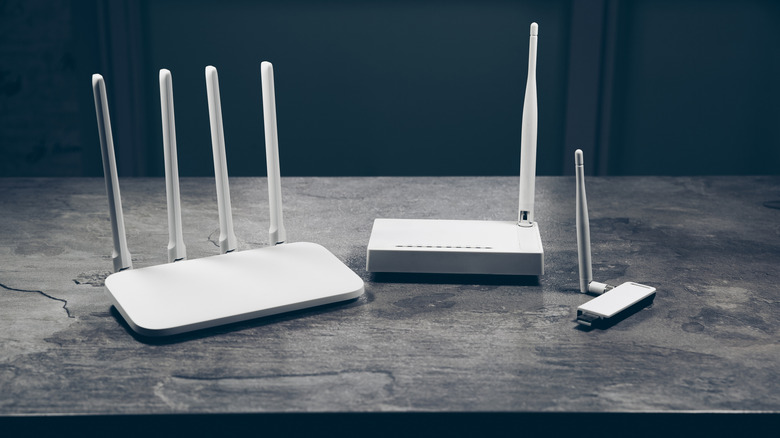
It won't stop working, but newly discovered security flaws may go unfixed.
Only_NewPhoto/Shutterstock
So long as the hardware is healthy, a router will continue connecting your devices to the internet long after the manufacturer stops releasing firmware updates. There's no built-in kill switch outside of eventual hardware failure that will silence your router forever. Unfortunately, once firmware updates cease to be a regular thing, your router loses its most dependable attribute for fixing newly-discovered security flaws.
The 2026 Formula 1 title race has become a two-horse race between Mercedes duo Kimi Antonelli and George Russell with eight rounds remaining.
Antonelli leads Russell by 66 points ahead of this weekend's Bahrain Grand Prix in Malaysia and it will be fascinating to see how the Italian responds following what he called his "worst weekend" of the season last time out in Baku.
Tyson Fury and Anthony Joshua's first press conference is expected to go ahead in London on Wednesday after a number of issues were resolved.
The British heavyweight rivals are set to go head-to-head for the first time since their blockbuster heavyweight fight was finally confirmed last week at Cardiff's Principality Stadium on December 11.
England manager Sarina Wiegman has named a 23-player squad for next month’s World Cup qualifying play-off against Greece, with Ella Toone and Chloe Kelly both missing out.
Kelly has yet to complete 90 minutes for Arsenal this season and has not started a game. The last time she was not called up by England was February 2025.
Fatima Ezzahra El Mansouri becomes the second woman to serve as prime minister in the Arab world.
Morocco’s King Mohammed VI has named Fatima Ezzahra El Mansouri as the country’s first female prime minister and the second-woman ever in the Arab world to serve in the position.
Iran’s Islamic Revolutionary Guard Corps (IRGC) has made a direct appeal to Americans, saying the United States government under President Donald Trump “must be changed”.
In a lengthy open letter (PDF) released on Tuesday, the IRGC tells Americans to “wake up” and “wrest control back from corrupt politicians”.
At a victory press conference, prior to her announcement as prime minister, El Mansouri was asked whether the state would need to make changes to accommodate her in Muslim religious ceremonies attended by the king, including Friday and Eid prayers, where men and women pray in separate sections.
Hope Again is the conference slogan. But what felt even more apt was Try Again.
Just forget about the last two years, after the party won a historic majority but where the mood never matched the achievement. Now, as conference delegates and MPs filed out of the hall after Andy Burnham’s first speech as prime minister, it was close to euphoria. Where the hell have you been all our lives? What have we been doing – when you were right there all along?
No evidence of "tactical contact" or the use of a stinger has been found before the A66 crash which killed five young men and two police officers, an initial investigation has revealed.